INTERGLAD is the International Glass Database System developed and first
released in 1991 by the New Glass Forum. INTERGLAD Ver. 8 is the latest
information system for glasses; it contains data on the properties and/or
structural features of approximately 380,000 types of glasses. It is designed
to enable users to easily extract and use a wide variety of information
suited to their purposes. It also enables users to predict properties of
glasses and to design glasses of new composition based on the collected
data. The NGF expects that this new version will become a favorite resource
of glass users and producers and will assist in the development of the
glass industry as well as related fields and scientific pursuits.
1. History of INTERGLAD
Work on the realization of the INTERGLAD International Glass Database began in 1987, which was the year in which the NGF was established, as part of its international contribution program. A group composed of glass researchers from both domestic universities and companies, led by Dr. Itaru Yasui, then a Professor at the University of Tokyo, worked on the database project from system design to data collection for three years, with the cooperation of several major foreign glass companies and the Dainippon Printing Company.
A CD-ROM containing the database system was released in April 1991 as the
world’s first glass database1. The original collected data encompassed approximately 100,000 glass compositions,
and the input of data continued to the point of 120,000 compositions in
Ver. 2, which was released in 1993, and 150,000 compositions in Ver. 3,
which was released in 1996.
Until Ver. 3, the database could be run only on the MS-DOS operating system,
using a CD-ROM. With the release of Ver. 4 in 1999, it became possible
to access the database on either a CD-ROM or the Internet, using Windows,
Macintosh, and Unix operating systems coupled with browser software. The
Internet version was developed by the Toppan Printing Company2. Additional data were added to the Internet version each year, with the
number of glass compositions reaching 180,000 by autumn of 2000.
The system’s functioning was greatly enhanced with the release of Ver.
5 in 2001. Besides improvements made to the registration function, data
analysis, composition/property prediction obtained by multiple regression
analysis3 and additivity equations, and user data registration functions were added;
these additions greatly improved the features offered by the database and
the convenience of users. These developments were achieved with the support
of the Ministry of Economy, Trade and Industry in cooperation with the
Fujitsu Co.
INTERGLAD Ver. 6 was developed from the end of 2002 to 2004 in cooperation with the Database Promotion Committee chaired by then Prof. Rikuo Ota of Kyoto Institute of Technology with the support of the Mizuho Information & Research Institute, Inc. This enterprise was part of the Research and Development to Promote the Creation and Utilization of an Intellectual Infrastructure program of the New Energy and Industrial Technology Development Organization (NEDO). Throughout the project, the focus was upon high reliability for both the data and system sides of INTERGLAD, with data being systematically reviewed4 and continually corrected as needed. In the multiple regression analysis,
a regression equation without a constant5 was added. In addition, an applet version that could be used without installing
the program on the user’s computer was added for increased user convenience
in November 2005.
From July 2005 to March 2007, the NGF developed a prototype of the world’s
first glass structure database6 related tools. This development was proceeded in cooperation with the Glass Structure Database Committee chaired by Professor Hiroyuki Inoue of the University of Tokyo as part of the Research and Development to Promote the Creation and Utilization of an Intellectual Infrastructure program of NEDO. The developed database of glass structures, which included factors such as interatomic distance, bond angle, ring structure, and coordination number was integrated into the newly released INTERGLAD Ver. 7 in 2009 (in Japan) and in 2010 (worldwide). Moreover, a multiple regression analysis tool with multiple polynomials7, a data interpolation tool that can determine high temperature properties with few data, and a periodic table for easy component selection during searches, etc. were included in Ver. 7. This version was also developed with the support of the Mizuho Information & Research Institute, Inc.
Successively various function improvements and addition of the additive
equations were done in Ver. 7 (~7.7). Ver. 8 has been released in 2019
with an auto-calculation tool for composition optimization by multiple
regression analysis and improvements for system environment changes. Java
Web Start has been available for Internet edition on almost main web browsers.
This version was also developed with the support of the Mizuho Information
& Research Institute, Inc.
Besides in December 2019, INTERGLAD Lite (Web) has beeb released. This
system is available for the annual users on any browser without using JAVA,
The users can search the property database by components, properties, data
sources, etc. XY plots and ternary plots are also available. https://www.interglad.jp/apps/
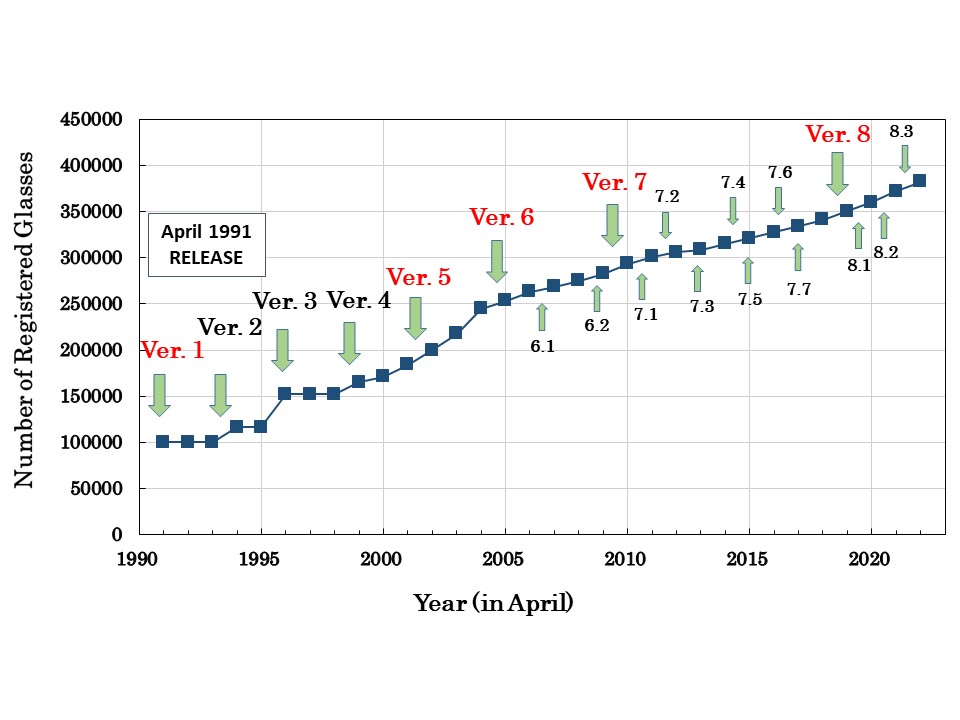
As shown in Fig. 1, each year, new data have been added to INTERGLAD. Currently
(in April 2022), INTERGLAD contains data for 383,000 types of glasses (structure
data: 15,000).
INTERGLAD has been used for the development of new types of glass, such
as low dispersion glass8 and lead-free crystal glass9, patent surveys related to glass composition, research into glass properties,
searches in the field of research on new glass composition, and the development
of new glass products. INTERGLAD has clearly played an important role in
the development of the glass industry and glass research around the world.
| Fig. 1 Successive Versions and Data Renewal of INTERGLAD. |
2. New Features and Improvements of INTERGLAD Ver. 8
1) Automatic calculation of glass designing (composition optimization)
by multiple regression analysis
In the previous method, a composition optimized with target properties was determined by repeated trial calculations, but in this method the user can get several optimized compositions by one-click from various model glass data. The automatic calculation is done by Least Squares Method for a target property. Therefore it is easier to get optimized compositions when using many model glasses in case of two or three target properties..
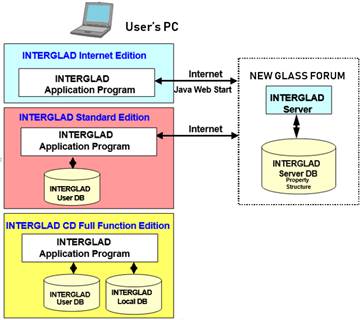
2) Use of Java Web Start for Internet edition
Java Applet, which was used for Internet edition of Ver. 7, can be used
on the limited web browsers, Internet Explorer, etc., but Java Web Start
is available on any main web browser with Java Ver. 7 or Ver. 8..
3) Small disc capacity of Standard edition
The system of Standard edition of Ver. 7 included the Local Database, but usually the user uses
only the Server Database and does use the Local Database. Therefore The
Local Database has been removed from the system, and the disc capacity
has become very small..
4) SSL(https) for security improvement of INTERGLAD system (from 8. 1).
5) Search by Article Number of Journals in Data Source (from 8. 2)
Registration of Article Number for Journals has been started from part
of papers issued in 2019..
6) Service for search with AND, OR, NOT of components (from 8. 3)
Complicated searches of components connected with AND, OR, NOT have been confirmed and the search program of some cases with values of %min, %max have been changed for easier understanding..
<Improvements on and after Ver. 7. 2>
7) Easier multiple regression analysis for properties (from Ver. 7. 2)
Responses to Question messages and corrections to Error messages can be performed semiautomatically for easier analysis..
8) Easier selection of ternary plot condition (from Ver. 7. 2)
All selections of conditions for a ternary plot such as 3 components and
property can be done in the [Ternary Plot] window, and the ternary plot
changes instantaneously.
9) Selection of marker shape and color in figures (from Ver. 7. 4)
The marker shapes and colors of plot points can be selected for XY plots
and partly ternary plots.
10) Multi-selection of data source (from Ver. 7. 3)
As a search condition, 4 data sources (categories) can be selected. To specify relationships among the selected data sources, AND, OR or NOT can be selected for each data source.
11) Easier search tools (from Ver. 7.5)
Any item of each category of appearance, feature & process and usage
can be used as search condition.
12) Increased additivity equations (from Ver. 7.3)
Three equations for standard point of viscosity10 and an equation for electrical conductivity11 both proposed by Fluegel have been added..
13) Continued registration of new data and improved reliability
New property data for 7,000~8,000 types of glasses and new structure data
for 500~1000 types of glasses are registered each year. And data corrections
are done continuously.
14) Renewed user’s manual for Ver. 8
The ID lists have been renewed with added data sources, components, properties, etc. The user’s manual is regularly updated in PDF and the latest PDF manual can be referenced and downloaded on the INTERGLAD web page at any time (for annual contract users)..
15) System renewal
The system has been totally renovated to be compatible with the latest
OS, Browser, and Java environment.
References
1 Y. Suzuki, Am. Ceram. Soc. Bull., 70 (1991) 219.
2 T. Saitou, H. Oguro, T. Fukami, T. Iseda, Proceedings of the Japan Society
of Information and Knowledge, May 1999, p.63.
3 I. Yasui, F. Utsuno, Am. Ceram. Soc. Bull., 72 (1993) 65.
4 T. Iseda, Y. Iwasa, S. Yoshida, T. Kawasaki, Proc. XX-ICG (ICG, Sept.
2004) 07-029.
5 F. Utsno, H. Inoue, I. Yasui, S. Tsuboi, T. Iseda, Proc. XX-ICG (ICG,
Sept. 2004) 07-030
6 K. Suzuki, T. Iseda, H. Inoue, ICG2007, A36.
7 K. Suzuki, T. Iseda, H. Inoue, A. Masuno, PACRIM8-S23-P179-2009.
8 M. Fukuoka, H. Kinoshita, S. Noda, Y. Morita, J. Ceram. Soc. Jap., 110(2002),
1073.
9 H. Satha, M. Remram, J. Simons, Proceedings of the International Symposium on Glass Problems (ICG, Sept. 1996) p.193.
10 A. Fluegel, Glass Technol.: Eur. J. Glass Sci. Technol. A, vol. 48(1)
(2007) 13-30.
11 A. Fluegel, D. A. Earl, A. K. Varshneya, http://glassproperties.com/resistivity/
(2007)..
3. Contents and Functions
The international glass database INTERGLAD Ver. 8 is an information system
that contains comprehensive data on approximately 350,000 types of glasses
(including inorganic amorphous materials such as oxide glasses, non-oxide
glasses, amorphous metals and glass-matrix composites, and oxide melts
and non-vitrified oxides). It was designed for a variety of uses and purposes.
Its main functions are four-fold:
1) Search for glass data,
2) Analysis of searched-for glass data,
3) Prediction of properties and the glass designing (composition optimization),
and
4) Registration of user data and its utilization.
(1) Collected data
The INTERGLAD data set is mainly composed of glass compositions and properties
drawn from five sources: data books, scientific journals, proceedings,
patents, and company catalogues. Original data assembled by the NGF are
also included.
Beginning with Ver. 5, the names of authors from scientific journals, data indicating glass-forming regions, and figures have been added to the collected data. Data on glass-forming regions in which only a single boundary exists have been also registered in Ver. 6. Information on precipitated crystals in glass-ceramics, raw materials for sol-gel processes, substrates of thin-film glasses, glass preparation methods, heat treatment conditions, and methods for determining properties have also been added.
Registrations of glass structural data were compiled for Ver. 7. Glass
structural data include atomic information (atomic distance, bond angle),
ring structure, coordination number, bridging oxygen information, oxidation
number, basicity, etc. as analyzed by IR-UV spectroscopy, Raman spectroscopy,
ESR, NMR, etc. With regard to the structural data, only the existence of
most of the structural data was indicated with an asterisk (*) as characterization
data in Ver. 6; however, other details including the numerical values were
not present in Ver. 6. INTERGLAD from Ver. 7 is composed of a property
database and a structure database.
The latest data are posted on the Internet version twice a year, and posting errors that occur during the collection of INTERGLAD data from various sources are corrected immediately.
(2) Search for glass data
The data and information required by users can be easily extracted using
more than 2,600 keywords or ID’s that are hierarchically arranged. Keywords
or IDs of the property database are classified by State (General Glasses
such as Glass, Glass-Ceramics, Composites; Melts; Non-vitrified; Unspecified);
Glass System (Oxide Glass such as Silica, Alkali Silicate, Alkaline-earth
Silicate; Other Glasses); Composition; Property (Mechanical, Physical;
Thermal; Optical; Electrical, Magnetic, Chemical, Biochemical; etc.); Shape,
Feature & Manufacturing Process, Usage (General; Energy, Nuclear, Radiation;
Optics, Optoelectronics; Electronics, Electrical; Illumination; Architecture,
Traffic, Industry; etc.); Data Source; etc. The keywords or IDs of the
structure database are likewise classified according to State, Glass System,
Composition, Structure Information (atmic distance, coordination number,
etc.), Measurement Method (Raman spectroscopy, NMR, etc.), and Data Source.
A search can be performed by setting at least one condition (keyword or
glass No., except State). The search tools in Ver. 7 are more user-friendly.
It is now possible to select a component using the periodic table or to
select a component or property by inputting a keyword.
The search function can direct one to the following contents:
1) Data on commercial glasses that can be extracted from sources other than catalogues,
2) Detailed descriptions that are generally displayed in the Data List of Property (Structure),
3) Grouped data from a given data source that can be displayed in the same table,
4) Reciprocal referencing between the property database and structure database, which is possible for the searched Data List and the Detail Data,
5) Unit conversions as well as arithmetic operations for components of
compositions and properties,
6) Comparison of values calculated using the additivity equations and fact
data.
(3) Analysis of searched-for glass data
The data searched by a user can be visualized using an XY Plot, a Ternary
Plot, and the Element Analysis. Frpm Ver. 7, the interpolation of high
temperature properties can be done with few data.
The analysis function accesses the following contents:
1) The relationships between two arbitrarily chosen variables from components,
properties and structures can be plotted on XY charts.
2) XY Plots for property and structure can be shown when the Data List
includes both property data and structure data.
3) High temperature property values for a glass at multiple temperatures
can be plotted on XY charts as Temperature-Property Plots that include
interpolated values.
4) Property and structure data can be displayed on a Ternary Plot of chemical
composition.
5) The frequency of appearance for each glass element can be shown as Element Distribution for groups of glasses that have specified properties.
(4) Prediction of properties and glass designing (composition optimization)
INTERGLAD employs two approaches to the prediction of glass properties:
1) Additivity equations (51 equations for 14 properties): The property
value of a glass having a specified chemical composition is calculated
using an additivity equation selected from a list of equations assembled
from papers published in scientific journals.
2) Multiple regression analysis: The relationship between the chemical
composition and any given property of a glass can be derived by means of
multiple regression analysis of the property values of searched-for glasses,
and prediction becomes possible using the derived regression equation.
Two types of equation, with and without a constant, are available.
A multiple regression analysis tool with multiple (quadratic or cubic)
polynomials is also available from Ver. 7. Not just one-component terms
but also two- and three-component terms can be used as explanatory variables.
This is effective for predicting the properties of many glasses for which
additivity is not indicated. Values predicted through regression analysis
can be compared with the measured values on an X-Y chart.
Glass compositions that fulfill all conditions of three properties can
be searched for on the screen using trial and error. From Ver. 8 in many
cases, the user can get optimized compositions by automatic calculation
using least squares method. It is also possible to display a designed composition
on a ternary plot and to compare positions within the glass-forming range.
Interpolated property data can also be utilized for multiple regression
analysis. The assistance dialogues make prediction easier.
(5) Registration of user data
Users of INTERGLAD can incorporate their own data in the INTERGLAD system
and make full use of the integrated datasets. Batch entry of many data
can be done using a simple import method. The user definitions of glass
codes and property labels are free. User data are stored in one’s PC. Because
the data is not externalized, no security problems can arise, even when
one’s PC is connected to the Internet (for the Standard edition).
(6) Convenient Help system
INTERGLAD incorporates the following Help features so that anyone can readily operate the system:
1) Help balloons: Help balloons are attached to every key element on the screen,
2) User’s manual: Full instructions on the use of INTERGLAD can be accessed
on-screen,
3) Explanations of terms: Various glass terms and their meanings are directly accessible on-screen as a Glossary,
4) Methods of measurement: Methods for measuring property values can also be accessed on-screen.
(7) Data reliability
The reliability of the data assembled in INTERGLAD is entirely dependent on the original data sources that were used: data books, scientific journals, patent applications, and catalogues. Based on the premise that erroneous data can be readily identified through the comparison of a number of data, the NGF did not examine each specific datum in INTERGLAD. However, obviously problematic data were deleted following the release of Ver. 6 through the use of a reliability estimation tool that was developed. In the future, all data will be rated on a scale ranging from low reliability to high reliability.
Every effort has been made to provide accurate data in INTERGLAD. However, the values, data, and information contained in this database cannot be guaranteed for accuracy or for freedom from errors or omissions. The use of INTERGLAD for any purpose is at the users’ own risk, and we disclaim any liability for loss, claims, or damages resulting from its use.
|
|